The Hidden German Heartbeat of the Hudson Valley: Stories of German Settlers, Survival, and Sauerbraten at Franzel
- Franz Brendle
- Feb 14
- 4 min read
Imagine stepping off a creaky ship onto the misty shores of the Hudson River, your boots sinking into fertile soil that whispers promises of a new life. That's how it began for thousands of Germans who traded the turmoil of Europe for the untamed beauty of New York's Hudson Valley centuries ago. Here at Franzel, our cozy modern German bistro in the charming town of Goshen, we don't just serve up steaming plates of goulash and frothy steins of imported beer—we're a living bridge to that vibrant heritage. Owned by chef Franz Brendle, inspired by the flavors of his family heritage and beyond, Franzel invites you to savor not just the food, but the tales of resilience that echo through our towns and villages, clubs, and even our street signs. Let's wander through history together, shall we? Grab a virtual pretzel, and let's dive in.
The Palatine Pioneers: Fleeing Flames and Finding Fertile Ground
Picture this: It's the early 1700s, and Europe is a battlefield. The Palatine Germans, hardy farmers from the Rhine Valley's southwest corner, have endured endless wars—the brutal Thirty Years' War, the Nine Years' War—coupled with famines, crushing taxes, and a winter so harsh in 1709 that rivers froze solid and vines withered. Desperate for escape, they heeded Queen Anne's call from Britain for German Settlers to: "Come to the colonies! Free land awaits!" But the journey? A nightmare of overcrowded ships, disease, and death. Yet, hope propelled them forward.
In 1708, a brave band led by Rev. Joshua Kocherthal docked near what’s now Newburgh in Orange County, planting the seeds of the first Palatine settlement. By 1710, waves more—around 3,000 souls—arrived, tasked with harvesting naval stores like tar and pitch for the British fleet in places like East Camp, today's aptly named Germantown in Columbia County. The gig flopped—rocky soil and high costs dashed those dreams—but these folks were no quitters. They fanned out, claiming lush lands in the Schoharie and Mohawk Valleys, and right here in the Hudson Valley. In our own Orange County, the "German Patent" of 1719 carved out prime riverfront in Newburgh, where they built homes, farms, and the county's first organized church—a Lutheran gathering that lives on as St. George's Episcopal today.
What drew them? The Hudson Valley's rolling hills and rich earth mirrored their beloved Rhine homeland. Religious freedom? Check. Land to call their own? Finally. These settlers weren't just survivors; they were shapers—introducing hearty crops, skilled crafts, and a spirit of community that still pulses through the Valley's veins. Their legacy? It's in the air we breathe, the ground we walk.
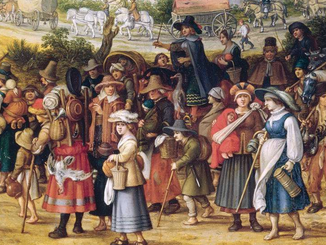
This evocative 17th-century scene captures the essence of those Palatine refugees, their weary eyes fixed on a horizon of hope across the Atlantic.

Echoes of War: New Waves of German Settlers After World Wars I and II
Fast-forward to the ashes of World War I. Germany in the 1920s? A whirlwind of hyperinflation, where a loaf of bread cost billions of marks, and political chaos reigned. Between 1918 and 1930, nearly 100,000 Germans fled to America, many filtering into New York's familiar embrace, including our Hudson Valley. Skilled artisans and families seeking stability joined existing enclaves, weaving their threads into the region's tapestry.
Then came World War II's shadow. Post-1945, refugees poured out from a shattered Europe—escaping Nazi ruins, displacement, and the Iron Curtain's chill. Anti-German vibes during both wars stung, eroding big-city spots like Manhattan's "Little Germany," but in quieter corners like the Hudson Valley, they found refuge. Think Washington Heights in the city, spilling into our area, or the Swiss, Polish, and Volga Germans who claimed Warwick's Pine Island Turnpike for its black-dirt farms, perfect for onions and resilience. War brides in the 1950s, displaced persons starting fresh—these folks faced prejudice but built anew, enriching our farms, factories, and festivals.
Smaller than the 19th-century floods, these waves still fortified the German soul here, blending old traditions with American grit amid the era's trials.
Living Legacies: From Street Signs to Steins Raised High
Now, let's stroll the streets—can you hear the whispers? Towns like Germantown in Columbia County? Straight-up named for those 1710 Palatines, a nod to their unyielding spirit. Street names in the Valley? They're family heirlooms: Rifenburgh, Clum, Fingar, Coons, Hover—echoes of farmers who turned wilderness into wonder. In Orange County, Montgomery's Palatine roots run deep, and Newburgh's German Patent lands host historic gems that transport you back.
But it's not just names; it's noise and cheer! German-American clubs thrive, like the Germania of Poughkeepsie, and The Mannerchor & Dammenchor of Kingston, where Gemütlichkeit— that warm, fuzzy feeling of togetherness—rules. Picture family feasts, folk dances, and events that keep the culture kicking. Oktoberfests explode across the region—Albany's got a big one, but our local bashes in the Hudson Valley? Lederhosen, live oompah bands, and beer gardens that make you feel like you've teleported to Munich.
Revelers at a Hudson Valley Oktoberfest, polka-ing under strings of lights—proof that German joy is timeless and infectious.

Even in Goshen, the influence simmers. Historic buildings blend German-Dutch vibes, and community events keep the flame alive. At Franzel, we channel it all: modern twists on classics in our bistro, treasures from Oma’s Laden (our little shop stocked with imported goodies, just like Oma's store back home). It's where history meets your plate.
Raise a Glass to Roots and Renewal at Franzel
From those storm-tossed Palatines to post-war dreamers, the Germans who chose the Hudson Valley didn't just settle—they thrived, leaving a legacy that's as hearty as our schnitzel. It's in our clubs' laughter, our streets' stories, and every bite at Franzel. So, why not join the narrative? Swing by our spot in Goshen for a taste of German bliss, a stein of tradition, and a slice of this enduring heritage. Prost to the past—and to you, for being part of the story!